You probably don't need twenty more daily games. Two or three that ask different things of you can be more enjoyable than a long list of puzzles you feel obliged to finish.
For geography, a useful mix is recognising a place, connecting places and reasoning about a place. Those skills overlap, but being good at one doesn't guarantee the others. You can recognise a country's outline without remembering its neighbours, or know its location without having much idea what it exports.
Here is a small routine built around those differences. We make Tradle Daily, one of the games below. The descriptions are based on the games' published rules and pages, checked in October 2026. This is a suggested combination, not a ranking based on playtesting or a promise about how long each puzzle takes.
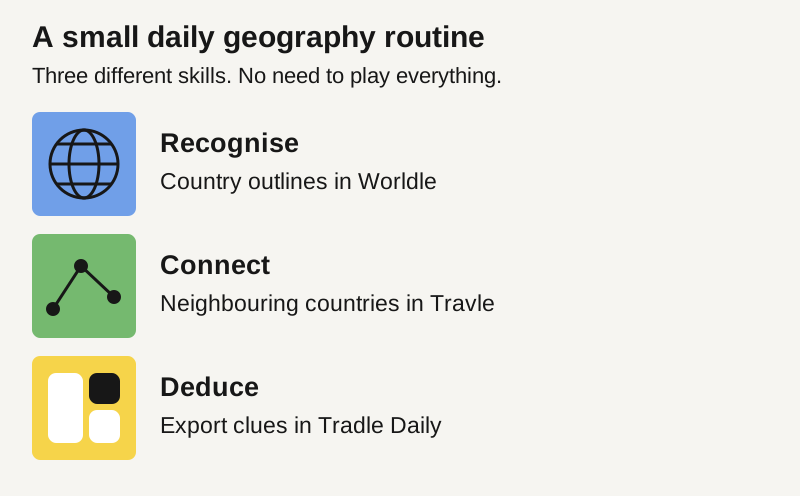
Start with recognition: Worldle
Worldle gives you a country or territory silhouette, with six guesses and distance and direction feedback. The daily puzzle is free, while archive access is part of its premium offering.
For this routine, use it as a test of visual memory. Before typing, notice one feature of the outline: a long peninsula, an unusually straight border, a compact shape. If you don't recognise it, that feature gives you something to remember when the answer is revealed.
Avoid treating a missed answer as a fact you ought to have known. An unfamiliar outline is exactly the sort of thing a daily puzzle can introduce without turning it into homework.
Then make a connection: Travle
Travle asks you to link a start country to an end country through neighbours. Knowing the destination doesn't remove the puzzle. You still need to work out which countries can form the route.
This pairs well with outline recognition because it makes you put places back into context. Try thinking through the whole route before entering a country. When you get stuck, identify the missing connection rather than simply guessing somewhere in the right region.
The game also has other modes, but the daily route gives this routine a clear stopping point. There is no requirement to keep going once you have finished it.
Finish with a different kind of clue: Tradle Daily
In Tradle Daily, the clue is an export treemap. Five guesses, with distance and direction feedback, let you work towards a country from the goods it sells abroad.
This adds a question that an outline can't answer: what makes this place economically distinctive? A broad metals category is only the beginning. Open it and you might find copper ores, refined gold or steel products, each suggesting a different line of thought.
After the reveal, pick one product to remember. You don't need a notebook full of trade statistics. “I didn't expect that country to export so much of this” is enough to give the puzzle a useful afterlife.
It is our game and it has its own daily answer. It is separate from OEC's original Tradle, which also uses exports as the basis for country deduction.
Two worthwhile substitutions
If outlines aren't your thing, replace Worldle with Globle. It reveals whether guessed countries are getting warmer as you move towards a mystery location. That makes the opening more exploratory. The aim is to solve it using as few guesses as you can, rather than recognising a supplied shape.
If you would rather study a picture, TimeGuessr offers a daily challenge based on locating and dating photographs. It adds historical observation to the geography. Make it a substitute for one of the other games, rather than another mandatory item on the list.
| You want to practise | A useful choice | What to notice afterwards |
|---|---|---|
| Country shapes | Worldle | One memorable feature of the outline |
| Relative locations | Globle | Where your first guess sent you astray |
| Borders and neighbours | Travle | The connection you couldn't recall |
| Economic geography | Tradle Daily | One distinctive product or combination |
| Visual and historical clues | TimeGuessr | A detail that helped locate or date the photo |
Give the routine a stopping rule
One daily round per chosen game is a reasonable limit. Bonus modes can be fun, but they don't have to become part of the habit. On a busy day, choose one game and leave the others.
If you play with someone else, compare the reasoning rather than just the score. “What made you try that country?” often produces a better conversation than “How many guesses?” Avoid revealing the answer until everyone has finished.
For more detail on how these games differ from an export puzzle, see our guide to games like Tradle. If you have chosen exports as your unfamiliar skill, start with a worked guide to reading the treemap.